
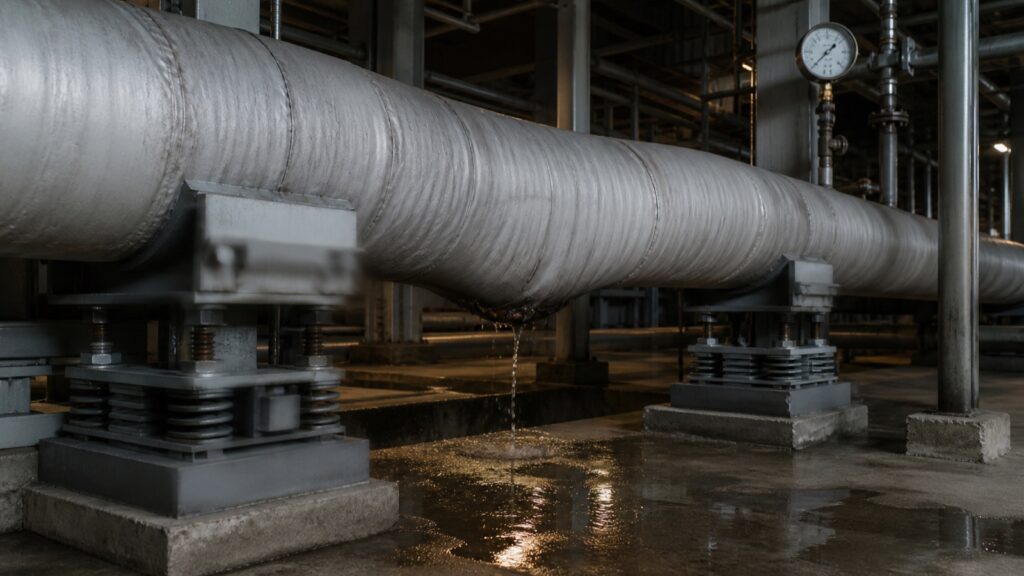
Water hammer is a pressure shock produced when moving condensate or another liquid changes velocity suddenly. In steam systems it can create violent banging, pipe movement and loads capable of damaging valves, supports, trap internals and heat-transfer equipment.
Why condensate becomes dangerous
Steam mains form condensate during warm-up and through ongoing heat loss. If drainage is inadequate, condensate collects at low points. High-velocity steam can drive this water into a slug. When the slug strikes a valve, elbow or closed end, its momentum is converted into a sharp pressure rise.
A second mechanism occurs when steam enters cooler condensate and collapses rapidly. The surrounding water rushes into the void, producing a local impact known as condensation-induced water hammer.
Common causes
- Missing or undersized drip legs
- Failed, isolated or incorrectly selected steam traps
- Poor pipe fall or sagging mains
- Fast opening of isolation valves during warm-up
- Condensate lifted without enough differential pressure
- Trap discharge into a highly pressurised return
- Incorrect concentric reducers that create pockets
- Heat exchangers operating under stall conditions
Warning signs
Banging on start-up, shaking supports, repeated gasket failure, cracked trap internals and unstable process temperature are important warnings. Do not treat the noise as normal. Identify when it occurs and inspect the corresponding drainage point, valve sequence and return pressure.
Prevention measures
- Pitch steam mains in the direction of flow and eliminate unintended low points.
- Install properly sized drain pockets at low points, ends of mains and suitable intervals.
- Use separators where wet steam is expected.
- Select traps for warm-up load, minimum differential pressure and air removal.
- Open steam isolation valves gradually during warm-up.
- Check valves and return pressure where condensate backflow is possible.
- Use pump-traps or pressure-operated pumps where stall prevents gravity drainage.
- Survey traps and strainers routinely.
Safety response
Severe hammer is an operating hazard. Keep personnel clear, reduce energy according to the plant’s safe operating procedure and have competent steam engineers inspect the system. Never loosen fittings on a live line to release trapped condensate.
PureSys India provides steam-system audits, trap surveys and condensate-return reviews. Request an assessment if hammer is recurring.
