
Why Choosing the Right Steam Trap Type Matters
Steam traps are the most numerous and maintenance-intensive component in any steam system. Selecting the wrong type leads to energy waste (failed-open traps blowing live steam), process problems (failed-closed traps flooding heat exchangers), or premature failure in service. Understanding the differences between steam trap types is essential for every plant engineer and maintenance manager.
PureSys India supplies all major steam trap types from GESTRA and Spirax Sarco. Browse our full steam traps range.
The Four Main Steam Trap Operating Principles
1. Thermodynamic Disc Traps
Operating principle: The disc trap operates on the difference in dynamic properties of steam and condensate. When condensate reaches the trap, it lifts the disc and flows out. When steam reaches the disc, it flashes to vapour in the control chamber above the disc — the higher velocity of the vapour creates a low-pressure zone that snaps the disc shut.
GESTRA models: DISCO series | Spirax Sarco models: TD42, TD52, UTD30, BTD52
- ✅ Compact and lightweight — easy to install in tight spaces
- ✅ Single moving part — inherently reliable
- ✅ Handles superheat and high pressures (up to 400 bar in GESTRA range)
- ✅ Self-draining — freeze-resistant
- ✅ Low cost
- ❌ Discharges condensate at or near steam temperature (slight subcooling)
- ❌ Cycles audibly — can cause noise complaints in quiet environments
- ❌ Not suitable for very low differential pressures
- ❌ Affected by back pressure — back pressure >50% inlet pressure causes cycling problems
Best for: Steam main and header draining, steam distribution lines, tracer lines, turbine drains
View thermodynamic steam traps.
2. Float & Thermostatic (F&T) Traps
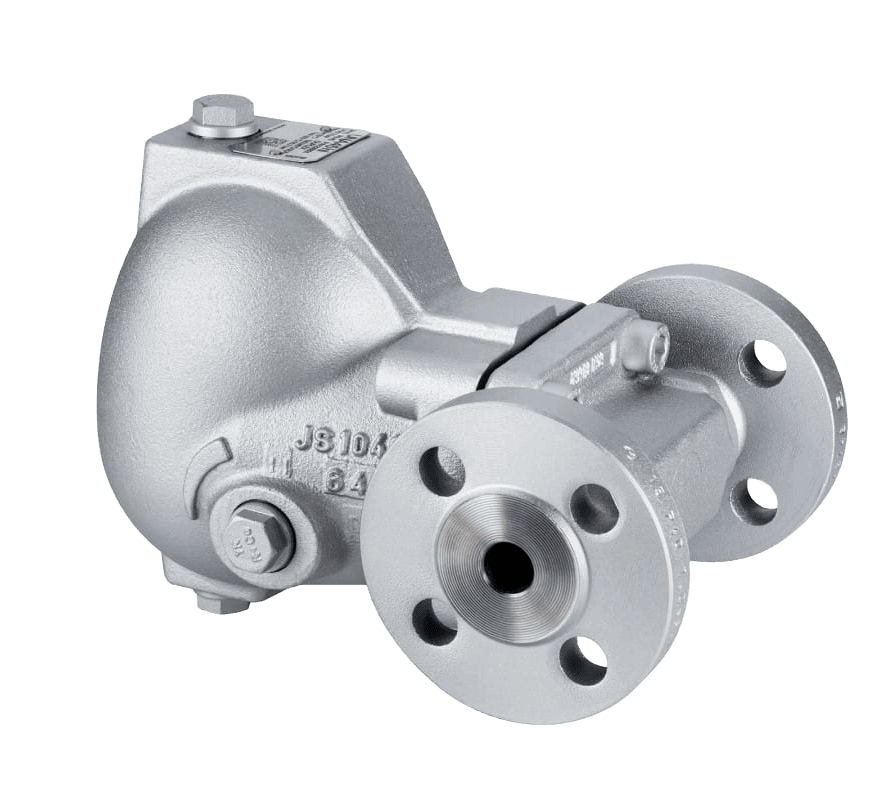
Operating principle: A ball float rises with condensate level and opens a valve proportionally — discharging condensate continuously at steam temperature. A separate thermostatic capsule vents air and CO₂ automatically.
GESTRA models: UNA 14, UNA 23, UNA 25, UNA 45, UNA 46 | Spirax Sarco models: FT14, FT37, FT43, FT44, FT47
- ✅ Continuous, proportional discharge — no condensate backup
- ✅ Excellent air venting on start-up
- ✅ Handles widely varying condensate loads efficiently
- ✅ Discharges condensate at steam temperature — maximum energy recovery
- ❌ Larger and heavier than thermodynamic traps
- ❌ Not suitable for very high pressures (typically limited to ~32 bar)
- ❌ Float can be damaged by severe water hammer
- ❌ Must be installed horizontally (float relies on gravity)
- ❌ Not self-draining — freeze protection needed in outdoor applications
Best for: Heat exchangers, process vessels, jacketed reactors, autoclaves, unit heaters, dryers
View float & thermostatic steam traps.
3. Bimetallic Steam Traps
Operating principle: Two bonded metal strips with different thermal expansion coefficients bend when heated — closing the valve as temperature rises towards steam temperature, and opening as the temperature falls (condensate present). The trap discharges subcooled condensate (below steam temperature).
GESTRA models: BK 15, BK 29, BK 45 | Spirax Sarco models: BT6, BT14, SBT
- ✅ Extremely robust — resistant to water hammer, vibration, and freezing
- ✅ Suitable for superheated steam service
- ✅ Can be installed in any orientation
- ✅ Excellent for outdoor and hazardous environments
- ✅ No moving parts exposed to steam
- ❌ Discharges subcooled condensate — condensate backup in the system
- ❌ Slow response to load changes — not suitable for variable condensate loads
- ❌ Poor air venting (air is not distinguished from subcooled condensate)
Best for: Steam tracing lines, outdoor tracer applications, superheated steam draining, hostile environments
View bimetallic steam traps.
4. Thermostatic (Bellows/Capsule) Traps
Operating principle: A capsule or bellows filled with a liquid/vapour mixture that boils below steam temperature expands when steam approaches — closing the valve. When subcooled condensate enters, the capsule contracts and the valve opens.
GESTRA models: MK 25, MK 35, MK 45 | Spirax Sarco models: AIM7, AIM12, SM/ST series
- ✅ Discharges condensate significantly subcooled — creates flash steam in condensate return (can be useful for low-pressure steam recovery)
- ✅ Excellent air venting — capsule responds to temperature, not just steam vs condensate
- ✅ Simple and compact design
- ✅ Can be used for air venting on its own
- ❌ Subcooling can cause condensate to back up in the system
- ❌ Capsule can be damaged by water hammer
- ❌ Limited to moderate pressures and temperatures
Best for: Steam tracing, steam mains air venting, radiator valves, low-pressure heating
Comparison Summary Table
| Feature | Thermodynamic | Float & Thermostatic | Bimetallic | Thermostatic Capsule |
|---|---|---|---|---|
| Discharge type | Intermittent | Continuous | Intermittent | Intermittent |
| Condensate temp at discharge | Near steam temp | Steam temperature | Subcooled | Subcooled |
| Air venting | Poor | Excellent (integral) | Poor | Excellent |
| Back pressure tolerance | Limited (<50%) | Good | Good | Good |
| Superheat suitability | Excellent | Poor | Excellent | Poor |
| Freeze resistance | Excellent | Poor | Excellent | Good |
| Water hammer resistance | Good | Moderate | Excellent | Poor |
| Size/cost | Small/Low | Larger/Medium | Small/Low | Small/Low |
| Best for | Steam mains | Heat exchangers | Tracers/Superheat | Tracers/Air venting |
Quick Selection Guide
- Steam main draining / header drain pots: Thermodynamic disc trap
- Heat exchangers / process vessels: Float & thermostatic trap
- Steam tracing (outdoor): Bimetallic or thermostatic capsule trap
- Superheated steam: Bimetallic or thermodynamic trap
- Autoclaves / sterilisers: Float & thermostatic (best air venting)
- Air venting only: Thermostatic capsule air vent
Expert Selection Help
PureSys India’s engineers provide free steam trap selection and sizing. Contact us with your application details or browse all steam traps from GESTRA and Spirax Sarco.
