
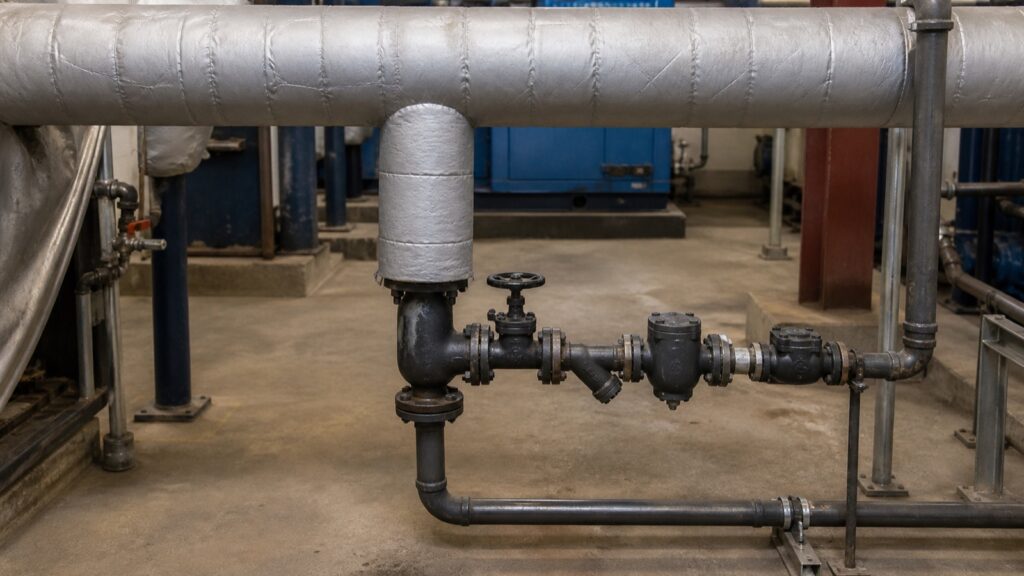
A good steam trap cannot protect a main if condensate cannot reach it. Water-hammer prevention therefore depends on the complete drainage arrangement: pipe fall, collection pocket, trap type, strainer, isolation, check valve and return line.
Collect condensate before trapping it
A small tapping from the bottom of a large main may let fast-moving condensate bridge over the opening. A full-size collection pocket or properly proportioned drip leg gives water a low-velocity space to separate from the steam flow before entering the trap set.
Drain points are normally considered at low points, the ends of mains, before rising sections, around separators and at intervals determined by pipe size, insulation, warm-up method and project standard.
Select for start-up and running conditions
Warm-up load may greatly exceed normal running condensate. Check trap capacity at the minimum differential pressure, including return-line backpressure and lift. Provide effective air venting so cold air does not delay warm-up.
Thermodynamic disc traps are commonly used for robust main drainage. Float-and-thermostatic traps provide continuous drainage and strong air venting where conditions favour them. Bimetallic designs can suit higher-pressure and superheated duties when correctly selected.
Check valves and sight checking
A check valve can prevent reverse condensate flow when the return becomes pressurised. Valsteam’s SCKi combines a sight glass with non-return action downstream of a trap; its official sheet recommends at least one metre separation from the trap to protect the glass from thermal shock.
Discharge piping rules
- Keep the line self-draining where possible.
- Avoid unnecessary lift and small-bore restrictions.
- Account for flash steam and simultaneous trap discharge.
- Do not connect into a flooded or overpressurised return without analysis.
- Provide safe isolation and strainer access for maintenance.
Trap stations simplify maintenance
A complete station may combine isolation, straining, trapping and non-return functions. Valsteam’s UniADCA CTS4U concept integrates upstream/downstream isolation, a strainer, check valve and universal trap connection, reducing field joints and potential leak paths.
Commissioning checklist
- Confirm flow direction and orientation.
- Flush debris before placing the trap in service.
- Warm the main slowly.
- Check discharge using temperature and ultrasonic methods.
- Record the trap location and model in the maintenance register.
For trap sizing and station design, see PureSys India’s steam-trap range or contact our engineers.
